Tuesday, November 22, 2011

OSWALT OR BUEHRLE OR WILSON, OH MY!


With baseball’s annual Winter Meeting now three weeks away, Nationals’ general manager Mike Rizzo continues to focus on adding an experienced center fielder and a veteran starting pitcher.

Roy Oswalt -- The Best Fit In Washington?
My guess is that if Rizzo is going to make a splash at the meetings, it’s going to be with a pitcher. If they have to, the Nationals can probably get by with a holdover from last season (Rick Ankiel or Roger Bernadina) or a platoon of veterans capable of giving the team some steady-if-unspectacular offense while providing steady defense.

But adding another veteran starter is imperative if the team is going to make a true pennant run. Sure, Brad Peacock or Ross Detwiler or Tommy Milone might come out of nowhere and give the team 12-14 wins, but they probably won’t.

One more quality starter to go along with Stephen Strasburg, Jordan Zimmermann, John Lannan and Chien-Ming Wang could actually make the Nationals—gulp, dare I say it?—an early favorite in the hunt for one of now two Wild Card berths.

There are several pitchers that meet Rizzo’s requirements, namely a veteran, “innings eater” type who doesn’t have a history of injury problems.

Right now, Mark Buehrle, Roy Oswalt and C.J. Wilson are the most coveted of the available free agents.

Who should be the Nationals’ top choice among the three? Let’s take a look at their comparative statistics:

Roy Oswalt (Age: 33)
Career Average: 16-10, 3.29, 8.7/2.1/7.9
2011: 9-10, 3.69, 9.9/2.1/6.0

TSN Scouting Report:

Assets:  Has pinpoint control and an ability to throw plenty of first-pitch strikes. He's also an innings-eater with a winning attitude and leadership qualities.

Flaws:  His diminutive stature has started to take its toll, as he's not as dominant as he used to be. Also gives up a few too many hits.
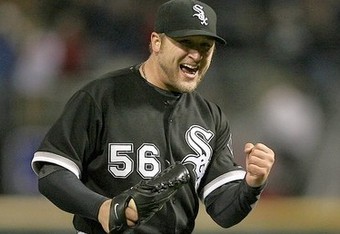
Mark Buehrle Seems GM Mike Rizzo's Favorite

Mark Buehrle (Age: 32)
Career Average: 15-11, 3.83, 9.5/2.0/5.1
2011: 13-9, 3.59, 9.7/2.0/4.8

TSN Scouting Report:

Assets:  One of the game's great work horses, he doesn't fatigue much late in the game. Logs a lot of innings, pitches to contact and can lead a staff. Is successful throwing an array of off-speed pitches.

Flaws:  When he loses focus, he gets knocked around for big innings. That's due to less-than-stellar velocity and average stuff. At times, he can take a while to regain his focus when on the mound.
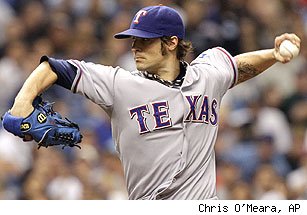
C.J. Wilson Has Just 2 Years of Starting Experience
C.J. Wilson (Age: 30)
Career Average (as starter): 16-8, 3.14, 7.4/3.5/7.9
2011: 16-7, 2.94, 7.9/3.8/8.1

TSN Scouting Report:

Assets: Pitches aggressively with a low-90s fastball that has great movement. Also boasts a good curve and solid change-up. Constantly challenges hitters. Is capable of dominating left-handed batters. Can close, set up or start.

Flaws: Right-handed hitters have a little more success than lefty bats, so greater refinement in his pitches could help. Must improve his durability and stamina to thrive in the starting rotation.

There is no question that all three pitchers have the potential to help the Nationals become contenders, but that doesn’t mean they all bring the same abilities.

Of the three, Wilson will likely cost the most and require the longest contract. Reports from multiple sources indicate that he has set his sights on a six-year, $120 million deal. And while there is no way he’s going to get that much, he’s going to come close as the top free-agent pitcher of the litter.

I think a more likely scenario is $80 million over five years with an easy-to-reach sixth year option.

That is way too much money for any free agent pitcher not named Sabathia, but it is especially too much considering that Wilson has only been a starter for two years and has only 73 starts under his belt.

I mean, who’s to say that he won’t revert back to his days before becoming a starter when he averaged 4.1 walks per nine-innings and had a bloated 4.30 ERA?

With the kind of money Wilson is going to get, the Nationals can buy a quality starter and a decent center fielder.

Signing Wilson makes no sense, not from a talent perspective and not from a financial perspective. Let the Yankees overpay for him.

And though Mark Buehrle has been a model of consistency for the Chicago White Sox, his stats don’t suggest that he is anything more than a good, consistent pitcher.

Mark Buehrle Seems Too Much Like This Guy
 And those stats look close enough to current Nationals’ lefty John Lannan that I’m not sure it makes sense to give the 32-year-old what he’s asking for, and no, I’m not suggesting John Lannan is the same pitcher as Mark Buehrle.

But take a look at their career averages based on a 162-game season:

Mark Buehrle:
15-11, 3.83 ERA, 223 Innings Pitched, 9.5 hits per 9 innings / 2.0 walks per 9 innings /5.1 strikeouts per 9 innings.

John Lannan:
10-14, 4.00, 200 Innings Pitched, 9.4 hits per 9 innings / 3.4 walks per 9 innings / 4.7 strikeouts per 9 innings.

Their lines just aren’t as different as you would expect. Lannan’s ERA is a bit higher, and he gives up one more walk per game, but his hits allowed and strikeouts allowed are about the same.

But look at this: In 33 starts, Lannan gave up 90 runs. Buehrle allowed 93 runs in one less start. That’s as close to identical two pitchers can be without being exactly identical.

And Lannan averaged 5.6 innings per start while Buehrle went 6.5 innings per start.

Man, that’s just too similar.

I doubt that John Lannan is going to be as successful as Buehrle over his career—in fact, I think we can count on that—but that doesn’t mean they aren’t similar pitchers. True, Buehrle has averaged 15 wins per major league season and Lannan only 10, but Lannan has spent his career on a truly terrible team.

Over Buehrle’s career, the White Sox have averaged 87 wins per season, and in the three seasons where they finished below .500, Buehrle had three of his worst seasons, winning 10 games in 2007 and 13 in both 2009 and 2011.

Lannan’s Nationals, on the other hand, have averaged just 66 wins during his time in Washington, 21 games fewer than the White Sox. Had he played with the White Sox during that same period, he would have likely averaged 12-13 wins per season.

So really, Mark Buehrle is a 2-3 win improvement over John Lannan, and that just doesn’t warrant the millions it will cost the team to get him.

In the end, I think that the least attractive of the three free agents could be the best fit in Washington.

Of the three, Roy Oswalt will require the least amount of guaranteed money and the fewest number of guaranteed contract years, due in part to injuries that have slowed him over the last couple of seasons.

From 2001 through 2010, Oswalt averaged 30 starts per season, going 15-8 with a fine 3.18 ERA. But he was limited to just 23 starts in 2011 and injuries robbed him of some of his efficiency. He went 9-10, 3.69 last season, giving up two more hits per nine-innings and striking out two less batters per nine.

Zimmermann & The Other Kids Could Use A Teacher
But Oswalt would bring far more to the Nationals than wins. He is a leader in the clubhouse, just the kind of guy that Mike Rizzo likes. The top three Washington starters—Strasburg, Zimmermann and Lannan—are all 26 or younger and fourth starter Chien-Ming Wang, while 31, has just 115 career starts, a relatively small number for his age. John Lannan, four years younger, has 13 more starts than Wang.

Oswalt could bring a winner’s mentality to the starting rotation. He could be a teacher, a leader and darn fine starter. Because of his age, it is likely that Washington would not want to / have to commit to a long-term deal, making that rotational slot available to one the team’s young pitchers in a relatively short period of time.

To be able to contend, the Washington Nationals need a “rock” in the rotation to give the kids time to turn winning ability into games won. Once that happens—say in a couple of years—the team could then afford to bring in one of the bevy of young arms they have stockpiled and still contend.

The Nationals contention window will open with the beginning of spring training and looks like it could be a five-year window. For now, the team will need an influx of outside veteran talent to win before ultimately letting the maturing youngsters lead them through those outlying years.

No question, though: it’s going to be a fun ride over the next few years. And goodness knows, after the last seven seasons, we’ve earned it.

Saturday, November 19, 2011

Bryce Harper IS The Outfielder That GM Mike Rizzo Is Looking For

Over the next six weeks, Washington Nationals team General Manager Mike Rizzo will burn up the phone lines at Nationals Park as he searches for the one or two remaining pieces that will transform the once moribund franchise into—this seems almost sacrilege to say—a true pennant contender.

Roy Oswalt Tops Mike Rizzo's List For FA Pitchers
As his team rocketed through September and finished the season on a 15-5 tear, Rizzo told reporters that his team was one starting pitcher and a center fielder away from joining the elite of the National League East.

Many free agent pitchers have been mentioned as possibilities for the Nationals rotation, including Mark Buerle (13-9, 3.59), Roy Oswalt (9-10, 3.69) and C.J. Wilson (16-7, 2.94).

 And though the Nationals have three stalwart prospects to fill that last spot in the rotation, Tommy Milone (1-0, 3.81), Brad Peacock (2-0, 0.75) and Ross Detwiler (4-5, 3.00) have yet to pitch a meaningful September game in their young careers.

Though their potential is undeniable, their lack of experience could be deadly to a potential pennant chase. The Nationals need a veteran quality starter to help calm the inevitable summer storms.

But the need for a center fielder is another matter entirely.

Heading into spring training, Michael Morse is a lock in left. After filling in at first when Adam LaRoche was lost for the year in mid May, the 29-year-old returns to his natural position after blossoming at the plate. Morse was perhaps the surprise of the National League last year, hitting .303-31-95 in his first season as a full-time player.

Jayson Werth is penciled in as the team’s right fielder. Werth’s first year in Washington was perhaps the team’s worst individual effort since Cristian Guzman back in 2005. In 150 games, the 32-year-old hit just .232-20-58.

But there is little doubt that Werth’s horrid season is likely not to be repeated in 2012. In his last three seasons with the Phillies, Werth averaged .279-29-84 with a solid .376 on-base percentage.

Chalk up last year to a combination of “just one of those years” and trying too hard to justify his $126 million contract.

That said, playing in that Philadelphia bandbox certainly puffed up his home run stats. From 2008 through 2010, Werth hit 50 homers at home and just 37 on the road.

The combination of a rebound year in 2012 along with the more spacious home ballpark should mean that Werth will give the Nationals a good-but-not-great season, something along the lines of .270-20-75.
That leaves the hole in center and a myriad of players to fill it. Grady Sizemore, who was non-tendered by the Indians following three injury-plagued seasons, seems the most logical choice of the group, though how much interest the team has for him at this point isn’t known.
Sizemore May Resign With Indians

Sizemore, a former member of the organization, averaged just .234-9-36 over the last three after hitting .279-28-81 from 2006-2008. Sizemore is seeking a one-year contract to prove his health as well as his worth.

And after his one year in center, he would move on to greener pastures, giving up his spot to that remarkable phenom currently percolating in the minors, Bryce Harper.

But as badly as the team wants to bring along the 19-year-old along slowly and cautiously, he seems to be proving at every stop along the way that he’s ready to face major league pitching right now.

Harper, the top overall pick in the MLB Amateur Draft in 2010, graduated from high school two years early and played in an advanced junior college league that used wood bats.

Hitting against 19-year-old pitchers in what should have been his junior year of high school, Harper was unstoppable, batting .442-29-89 in just 215 at-bats. That works out to 72 homers and 222 RBI over a 162-game season. Wow.

Harper’s first taste of professional baseball came in the Nationals’ Florida Instructional League following the 2010 season. He Batted .319 with a .407 on-base percentage and led his team in hits, home runs and runs batted in.

Though he originally was not ticketed to play in the highly touted Arizona Fall League that fall, Harper’s outstanding effort earned a spot on his team’s taxi squad, which limited his play to a couple of starts a week.

That said, the second-youngest player ever to participate in the AFL batted .343 with a .629 slugging percent in limited play.

Harper earned some significant playing time during the 2011 spring training, playing in 13 early games and he responded by hitting .389 with a .450 on-base percentage and a 1.006 OPS.

Like at virtually every other stop he’d made as a professional, Harper started slowly in the Low-A South Atlantic League as a member of the Hagerstown Suns this spring. But like virtually every stop he’s made, Harper then got hot and for six weeks, he was the hottest hitter in the league, perhaps in all of baseball. And then, like at virtually every stop he’s made, he plateaued and continued to be a very good player for the remainder of the season.
Bryce Harper

After 72 games, Harper had batted .318/.423/.554 with 14 home runs and 46 RBI and was promoted to Double-A Harrisburg. It was there that his cycle of slow starts and hot streaks ended. Oh, the slow start happened, but just as he began to heat up, injury ended his season.

In 129 at-bats, Harper hit .256/.329/.395 with 3 home runs and 12 RBI for the Senators.

There was some concern that the semi-struggle at Harrisburg was more the product of his being pushed too far too quickly within the Nationals’ system, but those fears were allayed over the past month in the hot desert sun in Arizona.

Playing against the top prospects across major league baseball, Harper batted .333/.400/.634 with six home runs and 26 RBI. Adjusted to a full major league season, those numbers would be .333-36-156 with 24 stolen bases.

And, oh yeah, he started slowly, then destroyed opposition pitching for three weeks, then plateaued and played solid baseball through the season’s end.

Now, I agree that it is difficult look at all of those teams and accompanying stats and be able to tell just how well he did. So let’s add up every swing, punch-out and home run he’s produced from that first day of spring training through the final out of the just completed Arizona Fall League season.

It pretty much adds up to a full major league season and gives a fairly good indication of the type of player Bryce Harper is:

Slash Line: .307/.398/.535

At-Bats: 498

Runs: 83

Hits: 153

Doubles: 32

Triples: 4

Home Runs: 23

Runs Batted In: 84

Stolen Bases: 31/38 (81.5%)

Walks: 73

Strikeouts: 111

That’s outstanding on a number of levels.

In the Low-A South Atlantic League, Harper was 18 playing against pitchers four years older than him. In the Double-A Eastern League, the median age is 25; some of those guys were in their eighth professional season while Harper should have been a senior in high school.

If he was able to put up all-star numbers when he was in essence the little brother trying to hit against all the neighborhood big brothers, how might he fare against players of his own age and experience level?

I don’t think we’ll ever know the answer to that because it’s not going to happen, because when the Nationals break camp and go north next spring, Bryce Harper needs to go with them.

It is a near certainty that whoever the Nationals are going to sign to play center, he will be gone by the end of the year, opening the door for Harper to begin playing every day in 2013.

But he’s ready now, and so that stop-gap center fielder just isn’t necessary.

The most important part of a young player’s game is the ability to adjust, and Harper’s continuous cycle of slow starts followed by blazing hot streaks is just that, Harper getting overmatched and then adjusting to how he’s being pitched.

There is no reason to believe that won’t happen at the major league level too. I have little doubt that Harper’s first couple of months would be beset by strikeouts and prolonged slumps. But in time, he would make the necessary adjustments and provide enough offense for the Nationals to make a real run at the post season.
 
Some worry that a bad start might harm Harper’s confidence in himself. But one thing that Harper doesn’t lack is confidence. And bad starts don’t end a player’s season before it starts. After 30 games last year, Michael Morse was hitting just .211/.253/.268 with a home run and just nine RBI, and his season ended quite nicely.

Jayson Werth’s first 30 games were almost as bad, and though he didn’t totally climb out of the hole he had dug for himself, he came close.

So there is no reason to believe that Harper couldn’t do the same, especially when he has a nice track record of doing just that.

And history suggests that Harper can make the jump to the majors this year.

Back in 1989, there was a 19-year-old phenom who many compare today to Bryce Harper. His name was Ken Griffey Jr. In his first few weeks as a major leaguer, he struggled mightily, hitting just .189/.246/.340 through early May.

But he made adjustments, learned from his mistakes, and by the end of the year hit .264-16-61 and finished third in Rookie of the Year balloting.

I suspect that Harper’s first-year stats would closely mirror those of Griffey, giving the team’s outfield more than enough offensive production to make a real run at the post season.

An outfield of Michael Morse, Jayson Werth and Bryce Harper could produce 70 home runs and 250 RBI in 2012. That compares favorably to the New York Yankees outfield trio of Brett Gardner, Curtis Granderson and Nick Swisher who combined to hit 71 home runs and drive in 240 RBI last year.

Starting Bryce Harper on Opening Day, does, however, have its drawbacks. His arbitration and free agency clocks would begin sooner, costing the team certainly more money and possibly the loss of Harper to free agency at an earlier date.

But in the here and now, none of that really matters. The Washington Nationals are finally in a position to win next year, thanks to equal parts of better players, the softening of the competition, and the possibility of a second wildcard spot in the playoffs.

In baseball, windows of opportunity open and close all too quickly and every chance to win needs to be grasped. For the Nationals, Grady Sizemore or Coco Crisp wouldn’t provide any better chance to win next year than Bryce Harper.

That being the case, it makes more sense to start Harper in right, move Werth to center, and leave Morse in left. Sure, there is a chance that Harper’s first year in the majors may be a bit substandard, but there is enough talent on the roster to make up for any short-term difficulties he may face.

And there is no question that Bryce Harper circa 2013 would be a far better player having a year of major league experience under his belt rather than another season in the minors.

While the Nationals can contend next year, 2013 will likely be the Nationals’ “big” year. The imperfections in the games of Danny Espinosa, Wilson Ramos and Ian Desmond will likely be gone with another year of experience. So it’s better to make

Thursday, July 28, 2011

Nationals Could Have Strong Left Field Platoon if Team Resigns Laynce Nix and Jonny Gomes in 2012

Jonny Gomes
The Washington Nationals acquired outfielder Jonny Gomes on Monday, a move that had most of the Nats' Nation scratching their collective heads. 

He's not young, and he's not an everyday player. He's also due to be a free agent at the end of the year. One of the "advantages" of this deal, or so says General Manager Mike Rizzo, is that he is projected to be a "Type B" free agent, which means the Nationals will gain a compensatory pick in next year's draft if they don't sign him.

Well, sure, but the team gave up two prospects to get him. I'm not sure I see the advantage in trading two prospects to get one.

I would much rather keep the 30-year-old Gomes and let him platoon with his former teammate and friend Laynce Nix in left field. Gomes doesn't hit right-hander's well, batting only .226/.308/.429 over his career while Nix is only .179/.230/.270 against lefties.

But take a look how the two of them would have produced in a platoon in 2011, using this year's production statistics as a guide. Typically, the left-hander in a platoon gets 450 at-bats in a season while the right-hander amasses about 150. Take a look: 

Nix: .287/.323/.537, 28 HR, 72 RBI
Gomes: .333/.439/.537, 9 HR, 33 RBI

Nix and Gomes, then, would have combined to hit .293 with 37 home runs and 105 RBI. 
Laynce Nix

The two players would give the Nationals some above-average pop in left while providing good-enough defense. And the player not starting would be a quality bat off the bench. 

Laynce Nix and Jonny Gomes would keep left field warm for as long as the Nationals need before Bryce Harper is ready to take over, say sometime late in 2012 or early in 2013. Something tells me, however, that the team won't be keen on resigning either of them this off-season. 

But here's hoping .....

Friday, July 1, 2011

Stephen Lombardozzi is Nationals' Answer At Leadoff And Second Base

Stephen Lombardozzi Playing for (AA) Harrisburg
While there are many question marks that need addressing before an average Washington Nationals' team becomes a good one, most believe that their middle infield--Danny Espinosa and Ian Desmond--is rock solid and immovable. Whatever trades may come and go, they will be left untouched.

And Espinosa certainly isn't going anywhere. The 24-year-old rookie from Long Beach State is on pace to hit 30 home runs and drive in more than 100 runs. And he might already be the best fielding second baseman in the National League.

And though shortstop Ian Desmond has started slowly at the plate, his defense is now always solid and at times sparkling. Most believe he will be a career .275 hitter with some pop and a lot of steals.

They are a great double-play combination, both young with a high upside, and yet I highly doubt that either of them will be playing their positions for Washington next year.

The Nationals, you see, are in dire need of a leadoff hitter. They have tried Roger Bernadina, Rick Ankiel, Espinosa--even Jayson Werth--at the top of the lineup with no success. And while Desmond may be the long-term answer at short, others are far less certain.

Ian Desmond's Days May Be Numbered
But playing at Triple-A Syracuse right now is a player who could bring stability, both to the top of the lineup and the middle of the infield.

His name is Stephen Lombardozzi.

The 22-year-old second baseman and Maryland native was taken in the 19th round of the 2008 amateur draft, and the son of former major league infielder Steve Lombardozzi has rocketed through the farm system in short order.

In four years, he has made stops in the Florida Gulf Coast League, Class-A Hagerstown, Double-A Harrisburg and was recently promoted to Triple-A Syracuse. In 1500 at-bats, the right-hander has hit .300/.374/.414, averaging 26 doubles and 24 steals per season.

After batting .309 with the Double-A Senators this season, he has rocked the International League to the tune of .413/.421/.468 in 49 at-bats.

Defensively, he is every bit as good as Espinosa. His career .985 fielding mark is outstanding and about the same as Espinosa's.

He's ready for the major leagues now.

So, what to do?

Lombardozzi & Jason Marquis Would Make a Great Pkg.
If the Nationals keep their team intact--perhaps call up a player or two from the minors--the team has a real chance of winning 75-80 games, manna from Heaven for long suffering Nationals' fans.

However, if they sell of some short-term parts, players like Ivan Rodriguez, Joey Cora and/or Jerry Hairston, Jason Marquis, Livan Hernandez and perhaps Todd Coffey, they may only win 70-73 games in 2011 but could wind up with an additional two or three Wilson Ramos-types that they received in trades.

If any of these trades occur, I feel certain that Espinosa would move back to his natural position of shortstop and Lombardozzi would take over at second. Desmond could be used in a trade package to a contender along with, say, Marquis or Livan, the type of trade that would certainly bring someone like Ramos--perhaps more than one--in return.

If the Nationals' offense was even just average this year, the team would be in a true pennant chase for the first time in six seasons. But they have the pieces already in place to resuscitate the bats for 2012. Here is my projected lineup for next year with my projected offensive statistics:

1--Lombardozzi (2B) .275-4-40, 25 steals

2--Werth (RF) .280-22-75, 20 steals

3--Zimmermann (3B) .290-27-90

4--Morse (LF) .280-25-90

5--LaRoche (1B).270-20-70

6--Espinosa (SS) .250-25-80

7--Bernadina (CF) .265-10-50, 25 steals

8--Ramos (C) .250-15-55

This of course assumes the return of LaRoche, but he is such a good fielder (and good enough hitter) that he needs to return in 2012. I am also unsure about Bernadina/center field. There might be a change there.

The first three spots in the rotation are likely already set. Both Strasburg and Zimmermann are capable of winning 15 games with an ERA near 3.00. John Lannan continues to show he's capable of being a pitcher who can throw 200 innings with an ERA between 3.80 and 4.00.

Tom Milone Could Be A Solid Starter By 2012
The last two spots could be filled through trade, free agent signing, or the promotion of one of several promising minor leaguer's, someone like Tom Milone, Ross Detwiler, Brad Meyers or Brad Peacock.

The bullpen, through current roster players (majors and minors) is set.

The addition of two more quality players, a starter and a center fielder, and this is a 90-win team capable of at least contending in 2012.

And man, am I excited.the 2008 amateur draft,

Friday, June 17, 2011

Tom Milone: Picture John Lannan Only Better

Tom Milone With Double-A Harrisburg In 2010
Tom Milone took the mound for the Triple-A Syracuse Chiefs a few nights ago and the crafty left-hander (crafty is the term used for lefties who can’t throw a fastball much faster than 90 mph) threw eight shutout innings, allowing eight hits and no walks while striking out nine.

Who is this guy that most Nationals’ fans have never heard of before? Think John Lannan but with a little better control.

I have enjoyed watching Lannan pitch the last three years, partly because he’s good, but also because I love it when underdogs succeed at the major league level.
An 11th-round pick in 2005 out of Siena College (17-5, 3.86), Lannan was considered to be no more than another organizational arm who might one day become a lefty specialist out of the pen.

In his first two seasons (Vermont and Single-A Savannah), that is how he pitched.

In 35 starts, Lannan was just 9-13 with a 4.89 ERA. In 2007, he blossomed and cut his hits per nine innings in half, and began hitting his spots.

In the span of just a couple of months, he was promoted to Double-A Harrisburg, then Triple-A Columbus and finally to the major leagues, where he started six games for Washington.

He finished the season with a record of 12-3, 2.31 ERA, and a slash line of 6.6/3.0/5.3 (hits/walks/strikeouts per nine innings).

Lannan’s career 32-43 record and 4.02 ERA with the Nationals is deceiving.

Cy Young Award winner Tim Lincecum had 26 quality starts two seasons ago, and former Cy Young Award winner Cliff Lee had 23.

Milone As A Potomac National in 2009
Lannan had 21.

In other words, he’s still young, still learning and he still gets clobbered when he doesn’t spot his pitches well.

Last season—probably due to a nagging arm injury—Lannan was horrible in the first half of the season, going 3-6, 5.76 before being sent down to Double-A Harrisburg in June. When he returned, however, he was his old self.

In 10 starts after being recalled, Lannan was 5-2, 3.42. Seven of those were "quality starts."

With a bit more luck and a little more offensive support, Lannan could win a dozen or so games each year for the next decade. He’s an ideal No. 5 starter.

In two starts this year, he’s pitched 10 innings, allowing 12 hits and three walks while striking out seven. Lannan’s ERA is 3.60.

Milone, like Lannan, is a lanky lefty who must pitch to spots to be successful.

He is eighth all-time in games started for Southern Cal.

In 2007, he was named Pitcher of the Year in the prestigious Cape Cod League with a record of 6-1 and a 2.92 ERA. He struck out 46 and walked just seven in 52 innings.

His next summer was spent in Wenatchee, Wash., pitching in a West Coast summer league. In 51 innings, Milone went 6-1 with a 2.61 ERA.

Against some of the best college hitters, Milone combined to go 12-2 (2.81 ERA) while striking out 101 in 103 innings. He walked just 13.

But a lack of a dominating fastball, and a so-so 16-17 career record with a 4.78 ERA at Southern Cal, relegated Milone to a 10th-round afterthought in the 2008 amateur draft.

John Lannan With Potomac
Though major league scouts didn’t think much of his ability, Milone was confident that he would succeed.

Pitching for Vermont and Hagerstown that first year, Milone crafted a record of 1-6 but with a solid 3.51 ERA. He allowed 10.3 hits per nine innings but just 1.3 walks.

Nationals’ scouts saw enough to promote him to High-A Potomac for the 2009 season. And just like Lannan two seasons earlier, Milone blossomed.

After watching him pitch in a bullpen session early in the year, Potomac pitching coach Paul Menhart approached Milone about adding a cut fastball to his repertoire.

Pitching to contact is fine, he said, but disguising his 87 mph fastball would help him greatly.

Milone’s cutter looks like his fastball but dives at the last second. Against right-handers, it first dives in, then away as it crosses the plate.

His ERA was 3.89 when he began to throw his new pitch in early July.

By the end of the year it had dropped to 2.91, best on the team. His batting-average against, .275 the season before, was just .252 with Potomac.

Milone’s fastball tops out at 87 mph, but usually sits in the 84-86 mph range. His curveball is sharp and about 10 mph slower than his fastball, providing good separation.

His changeup, though, is by far his best pitch; one he can throw wherever he wants and at any point in the count.

His control is remarkable. Over his minor league career, Milone has walked just 68 while striking out 310, more than a 4-to-1 strikeout to walk ratio.

Milone has trouble when he’s not hitting his spots. When facing a walk, he tends to throw his fastball down the middle of the plate, a bad place for a slow fastball.

But that is a peril that all contact pitchers face. If you don’t have an “out” pitch, there just aren’t many safe pitches to throw.

Overall, Milone’s minor league numbers are similar to—and in some cases much better than— Lannan’s. Both players have started exactly 62 minor league games:

Record

Lannan: 22-20 (.524)

Milone: 29-20 (.610)

ERA

Lannan: 3.95

Milone: 3.08
Opponent’s Batting Average

Lannan: .258

Milone: .255

Hits/Walks/Strikeouts Per Nine-Innings

Lannan: 8.9/3.4/6.3

Milone: 9.0/1.5/7.6

No, that's not a misprint. In 62 games he has allowed just 1.5 walks per nine-innings. To give that number some context, Stephen Strasburg, who in considered be one of the best control pitchers ever, allowed 2.1 walks per nine innings in his time with Double-A Harrisburg last year.

No, Milone is not Strasburg but he has Strasburg control.

One would think that Milone might have a major league career similar to Lannan, that of a mid-to-back-of-the-rotation starter who can be counted on to win 10 to 14 games a year.

Sure, Milone is not on any watch list and isn’t considered much of a prospect. But Lannan didn’t show up as a true prospect until the 2008 season, after he had already pitched in the major leagues.

Milone has a prospect grade of “C” and is lumped together with a bevy of other non-prospect types like Taylor Jordan, Nathan Karns and Pat Lehman.

I am in no way suggesting that Milone is going to repeat the success of Lannan.

But he has similar tools, has even better control, and at 23, is mowing down older and more experienced opponents in the Eastern League.

Lannan was also 23 when he pitched for Harrisburg.

Yes, it seems unlikely that a 10th-rounder will eventually make the Nationals’ starting rotation, especially when you consider that the Nationals will have a solid rotation when all of the team’s walking-wounded return to the major league roster.

But isn’t that the same thing we all said about Lannan, the 11th-round selection from Siena College?

He’ll pitch for Triple-A Syracuse this year and will be just a phone call away from the major leagues.

Suddenly, the Nationals have an embarrassment of riches when it comes to young pitchers, and it’s about time. The 2011 season is looking better and better with each passing day.

Wednesday, June 15, 2011

With Adam La Roche Out For The Year, Who Is Nationals' Long-Term Answer At First Base?

Adam La Roche
Now that Adam La Roche is "officially" out for the year, you have to wonder how his loss is going to effect the team beyond the last 100 or so games remaining in 2011.

La Roche will likely be 100-percent healthy by next spring and if given the opportunity will provide the Nationals the semi-big bat that they expected this season.

Over his six full seasons in the major leagues (2005-2010), La Roche has averaged .271/.340/.488 with 28 homers and 97 RBI over a full 162 game season, never missing any significant time due to injuries. There is no reason to believe that he won't return from shoulder surgery and hit .275-20-80 while playing flawless defense.

But do the Nationals want to do that? I doubt that the team will keep him beyond his current contract which expires at the end of the 2012 season. But if not La Roche, who then is the Nationals long-term solution at first base?

Well, it could be Michael Morse, who took over for La Roche earlier this year. In his first four seasons with the Seattle Mariners, Morse batted .300/.365/.397 with just 3 homers and 37 RBI in 300 at-bats. But since coming to Washington in 2009, the 29-year-old has hit .290/.344/.515 with 28 home runs and 88 RBI in 503 at-bats.

Michael Morse Sans Beard
This season, he is on pace to hit .290-30-104 while playing flawless defense at first. I keep saying that he's no Adam La Roche, but thus far he's been just that.

The Nationals also have two pretty solid prospects who could take over for La Roche in 2013, Chris Marrero at Triple-A Syracuse and Tyler Moore of Double-A Harrisburg.

The 22-year-old Marrero is a former first-round pick who former General Manager Jim Bowden chose for his bat. Now in his sixth minor league season, Marrero has averaged .282-20-85 per season and is on pace to bat .290-20-83 for the Chiefs this season.

The problem has always been his glove. Drafted as a third baseman the year after the Nationals took Ryan Zimmerman, he was moved to the outfield and quickly failed there. From 2008-2010, he played exclusively at first base and averaged 20 errors per season. But his defense looked vastly improved this past spring and in 61 games this year Marrero has committed just two miscues.

Several coaches have publicly said that Marrero's glove is now ready for the major leagues.

Moore, at 24 is two years older than Marrero (Marrero was drafted directly out of high school) and wasn't considered much of a prospect until last season when he launched 31 homers and drove in 111 runs for Class-A Potomac. That earned him a promotion to Double-A Harrisburg and is currently on pace to hit .273-26-80 for the Senators.

Defensively, he's always been good enough but not particularly great. he's averaged 10 errors per season and has a career .990 fielding mark (La Roche, considered one of baseball's best defenders, has a career .994 fielding percent).

So, what to do?

Assuming that he stays healthy, La Roche brings a stellar glove and power bat to the Nationals. Forget 2011; he is Mr. Reliability. Wind him up and he'll hit .275-20-80, certainly enough production when considering the runs he saves in field.

Morse has now proven he is an everyday major leaguer. He plays acceptable defense in left and seems above-average at first. He's 29 and looks to be able to provide 25-30 homers a year for the next four or five seasons for the Nationals. He could play in left field just as easily as at first.

Chris Marrero
And now Marrero's glove is as major-league ready as his bat. No, he'll never be a star, but he could become a quality complementary piece that all champion caliber teams need to be successful.

Tyler Moore could be the best pure power hitter among the group. Over the past two years, he's averaged a home run every 17 at-bats. Over a 550 at-bat season, that works out to 33 home runs (Marrero has averaged a homer every 26 at-bats, or about 21 homers over a full major league season).

I think the wild card in all of this is Bryce Harper. If all goes as planned, Harper will make it to the major leagues sometime next year, probably near the half-way point of the season. But when he gets here, where will he play? I don't think he's ready to be an everyday center-fielder, which means he will probably take over in left (I doubt a 19-year-old is going to supplant Jayson Werth in right).

So here's how the dominoes will fall:

Morse will remain at first for the rest of this season. Laynce Nix will be the team's left-fielder against righties and is on pace to hit .296-22-64 this year. This off season, the Nationals trade for a real center fielder who can succeed at the top of the order, perhaps using Nix as part of the package.

Adam La Roche returns in 2012 and becomes the team's first baseman with Morse returning to left. When Harper finally makes it to Washington, the contending teams will begin looking to add veteran players for their pennant chases, players like Adam La Roche.

Tyler Moore With Mississippi State
The Nationals trade La Roche, move Morse back to first, and Harper takes over in left. Werth remains in right and center is covered by the player they traded for, the guy that probably cost them a pitching prospect or a back-end-of-the-rotation major leaguer (or both), either Moore or Marrero and one more player, maybe Roger Bernadina or Nix.

With Stephen Strasburg back in the rotation and Bryce Harper in the outfield, the difference between just "another" season in 2012 and a special one could be that guy who ends up leading off and playing center.

Hopefully, they find the right guy.

Saturday, June 11, 2011

Projecting Bryce Harper

Nestled around a slow start and a short slump this year, Bryce Harper is producing the kind of season befitting baseball's premier minor leaguer. 

His high school graduating class received their diplomas about the same time that Harper crushed a 480-foot home run a few days back. 

Instead of kissing his high school sweetheart at the prom, he blew a kiss at the opposing pitcher. 

One day soon--probably after he plays in the South Atlantic League All Star game--Harper will be promoted, likely bypassing High-A Potomac and their bad playing field and landing at Double-A Harrisburg, where he will play against baseball's best prospects. 

My guess is that he'll reach Washington sometime next season, just after the Nationals have gained all the leverage they can with his potential arbitration and free agent status. And their he'll stay until the riches of a Scott Boras free agency come calling.

But how good has he been thus far in 2011? His offensive statistics, projected over a full season look like this:

AB: 506--Runs: 98--Hits: 172--Doubles: 33--Triples: 2--Home Runs: 33--RBI: 103--Steals: 30--Walks: 80--Strikeouts: 122. Add to this a .341 batting average, .433 on-base percent and .607 slugging mark and it seems remarkable that he hasn't yet been promoted. 

And if based on a major league 162 game season, he'd be on his way to hitting .341-38-117 with 30 stolen bases.

Harper will likely settle in to center field this time next year and will bring another potent bat to the Nationals' lineup. A middle-of-the-lineup that features Jayson Werth, Ryan Zimmerman, Michael Morse, Bryan Harper and (possibly) Adam LaRoche will have little trouble scoring runs. 

Add a (hopefully) healthy Anthony Rendon and this truly can be a team that contends in 2012.


Thursday, May 5, 2011

Stephen Strasburg's Former Catcher Promoted To Potomac


Selik In Junior College
That a player was promoted from Low-A Hagerstown to High-A Potomac this early in the season is a surprise to no one.

That it wasn't Bryce Harper is.

Twenty-three-year-old Cameron Selik, the Nationals' 22nd round pick in last year's amateur draft, is now with the Potomac Nationals of the Carolina League and should make his first start with the team sometime this weekend.

The San Diego native had a good-but-not great career with the University of Kansas, and began his professional career last summer as a reliever for the short-season Vermont Lake Monsters. In 28 innings, he went 1-0 with a 2.54 ERA, striking out 10.2 per nine-innings while walking 4.1.

He moved into Hagerstown's rotation this year and dominated, going 3-0 in five starts with a minuscule 0.31 ERA (best in all of minor league baseball), striking out 9.3 per nine-innings and dropping his walk rate from 4.1 last year to 0.9 this season. His strikeout-to-walk ration last year was an above average 2.4:1. This year it's 10:1.

John Sickels said that the 6'3," 240 pounder is a "strong legs" type of pitcher with a decent fastball that tops out at 92 mph and breaking ball with a "nasty" bite to it.


Starting For The Kansas Jayhawks
A few weeks after Sickels' scouting report was published, Selik hit 95 mph a couple of times in a start against Baylor and he seems finally over his Tommy John Surgery from three years ago.

He grew up catching Stephen Strasburg and started his pitching career in junior college as a member of the rotation as well as being one of the team's closers.

MASN's Byron Kerr talked to Suns' play-by-play announcer Bryan Holland who said that "He has a devastating slider that slips low and away. Cameron also has a great differential in speed between his fastball, slider, and changeup. This makes him virtually unhittable when the batter has two strikes on him."

It would seem that Selik has joined the cabal of Nationals' minor league pitchers on the fast track to the major leagues, but a 23-year-old pitcher in the South Atlantic League should dominate the competition.

Let's see what happens in Potomac this summer before jumping to any conclusions about his future.

Tuesday, May 3, 2011

South Atlantic League Pitching Can't Contain Bryce Harper

No matter what happens, Bryce Harper won't be playing baseball for the Washington Nationals in 2011.

That was the guarantee that came from pretty much every one within the organization.

Too much pressure on the kid, they said.

And a couple of weeks ago, they seemed to be clairvoyant. The kid with his own Sports Illustrated cover was batting .235 and hat just one home run. Since then, though, Harper is proving to be every bit the player we all thought he'd be.

In 32 at-bats since April 21st, Harper is batting .500 with six doubles and five home runs. He's driven in 14 runs. He slugging at a 1.156 clip and his on-base percent is .600.

He's now on pace for a record-setting season that would look like this:

At-bats: 569
Runs: 120
Hits: 205
Doubles: 60
Triples: 0
Home runs: 45
RBI: 150
Stolen Bases: 30

Batting Average: 358
On-Base Percent: .600
Slugging Percent: .697
OPS: 1.153

He's on track to walk 105 times while striking out 150. However, since mid April, he's walking more and striking out less, so those numbers will likely look a great deal different by September.

I wouldn't count on the Class-A South Atlantic League pitchers figuring him out anytime soon. They were getting him out easily during the season's first couple of weeks until Harper made an adjustment.

Harper is obviously dominating Sally League pitching. The question is how long the Nationals will let him remain before he is promoted to High-A Potomac. Right now, game time is little more than enhanced batting practice for the Las Vegas native and isn't helping his development.

Currently, Harper is ninth in the league in batting, third in doubles, home runs and RBI, sixth in on-base percentage and fourth in slugging percent. What makes his production even more impressive is his age. Catcher Chris Wallace has similar numbers (.384-7-24) to Harper but is 23. John Massanari (.388-7-23) is 25. Matt Curry (.375-4-19) is 24.

Bryce Harper is 18 years old and in his first professional season.

The team is probably beginning to firm up the date when Harper will be promoted to High-A Potomac, and there is little doubt he'll finish the 2011 season at Double-A Harrisburg. Another good spring (remember, he batted  .389/.450/.889 this year in Viera) and he could very well find himself as the team's starting center fielder this time next year.

This is a team that could make the jump from bad to good very quickly. With Bryce Harper and Stephen Strasburg on the team in 2012, just about anything is possible.

Friday, April 29, 2011

Marquis Mania in Washington

This time last year, Jason Marquis--one of the biggest names to sign with the Washington Nationals in the days before Jason Werth-- had started three games and lost all of them, limping into the clubhouse after that last one with a 20.52 ERA.

It was obvious that for the first time something was very wrong with his precious right arm. In 12 major league seasons, the 31-year-old had averaged 12 wins per season with a 4.54 ERA. Now, just a season removed from being an All Star, he was the worst starter on a bad team.

Eventually, bone chips were found and surgery was performed. He rejoined the team in August and went 2-6 with a solid 4.29 ERA. Marquis continued that good pitching into 2011; after Friday night's complete game win against the San Francisco Giants, he is now 3-0 with a 2.66 ERA, striking out 6.6 batters per nine-innings while walking just 1.8.

He is tough, he is a competitor, and last year was the first of his career that he didn't play in the post season.

He's a winner.

Many within the organization were hoping that he'd be healthy enough to trade sometime this summer for a prospect or two. He is, after all, in the final year of his two-year contract. But really, trading Marquis makes no sense at all.

The Nationals are expected to begin the 2012 season with a rotation of Stephen Strasburg, Jordan Zimmermann, Ross Detwiler and John Lannan. The fifth spot could easily be filled by Livan Hernandez or one of the young-but-ready kids working their way up the system.
But Marquis should be that man. He's mature, he wants to win and his past record tells a story of a winner. The rotation needs a veteran presence, a guy who runs the clubhouse who can also still win half of his games.

And that's Jason Marquis.

Before the Washington Nationals can be great, they have to be steady. And to be steady, they must have a pitcher who can be effective every fifth day, someone who can protect the team and give them a chance to win each game he pitches.

Jason Marquis is worth his contract dollars, finally. But to make those millions worthwhile, the Nationals need to extend him for two more years.

And give the rotation's children a chance to grow up.

Bryce Harper Looking Better Every Day

After a slow start, Hagerstown's Bryce Harper is on a tear. In 62 at-bats, the 19-year-old is batting .323-5-18 for the Class-A Suns.

But take a look at what he's done expanded to 550 at-bats, a typical major league season:

Runs: 126
Hits: 180
Doubles: 45
Triples: 0
Home Runs: 45
RBI: 162
Stolen Bases: 36
Walks: 100
Strikeouts: 153
On-Base Percent: .425
Slugging Percent: .645

Ten days ago, he was hitting .235. Today, he's pretty much got the South Atlantic League pitchers figured out. Left there for the entire season, my guess is he'd hit somewhere around .325-30-110 with 30 steals. But I think the Nationals will want to challenge him again, possibly moving him up to High-A Potomac in July.

One thing's for sure though: he's every bit the player we thought he'd be.

Thursday, April 28, 2011

Recent Losses Harder Because They've Become Less Expected

Sometimes, being a fan of the Washington Nationals can be very troubling.

Daniel Rosenbaum -- Pitcher

Seven seasons ago they marched into the All Star break in first place in the National League East with a record of 50-31. They added Preston Wilson and Devi Cruz for the pennant run and seemed ready to continue the magic all the way to the World Series.

Buster Onley was even asked at the All Star break if the Nationals could win the division. “Sure, why not!” was his reply.
 The Nationals returned after the All Star break confident and ready. But since then, Washington has gone 361-529, winning barely forty-percent of their games.

And yet throughout all this losing, all the embarrassment, all the jokes and all the refusal of so many quality players to come to Washington, the losses that are beginning to pile up now have been the hardest.


Because they are so close to being so good.

It’s one thing when the team loses 100 games and a quick glance at the rosters of the top two or three minor league teams verifies that there is no help on the way. But that’s not the case now. A quick count finds at least 20 players currently with Triple-A Syracuse and Double-A Harrisburg who will in the next couple of years don a Nationals uniform.

Some will be starters, one or two an all star, and many will fill support roles. But they’ll be here.

For years, the team had to hope that the few minor league players who were supposed to blossom did. Now, players who weren’t being counted on are stepping up.

After a couple of years derailed by injuries, Brad Meyers is 3-1 for Harrisburg with a 2.95 ERA. In 21 innings, he’s struck out 27 and walked no one. Brad Peacock, also with Harrisburg, is 2-1, 1.59, though his control isn’t quite as good as Meyers. In 17 innings, he’s struck out 21 and walked two.

No, the minor leagues aren’t loaded, but they are producing. By 2013, and with a little luck, it could produce an entire roster of capable major league players.

They’re t-h-a-t close.
Tyler Moore -- 1B
And the major league roster keeps showing flashes of brilliance that last a game or two before it returns to the ooze and muck of mediocrity.

The Nationals early season record is about where most of us thought they’d be, though things aren’t boding well for the rest of the season. They reached two games over .500 because an overachieving pitching staff made up for a lackluster offense.

But now—with the exception of Tom Gorzelanny last night—the starters are struggling right alongside the hitters.

No offense. No pitching. No hope?

No way.

These losses are difficult because we all know that hope is coming. Stephen Strasburg will be back by next season and Bryce Harper should be the every-day center fielder by 2013. One or two of those young pitching prospects (Tom Milone, Brad Meyers, Daniel Rosenbaum, etc.) will further embolden the starting rotation.

And really, other than left field and first, the Nationals’ starting eight is pretty much set once Harper makes it to Washington.

It’s because the future looks much brighter that these losses are harder to take. At some point, the Nationals will start winning games regularly and leave this nightmare behind. I mean, you start Stephen Strasburg and have Ryan Zimmerman, Jayson Werth, Bryce Harper and Wilson Ramos fill the middle of your lineup.

What’s not to like?

So, for now, the losses will hurt a little more because they are less expected. But in the end, the team will likely win 75 or so games this year (I mean, the offense has to warm up eventually) and another Jayson Werth type of free agency signing over the winter should produce a team on the periphery of contention.

It has to happen sooner or later. Really.