Sunday, December 25, 2011

$26 Million For Carlos Beltran? Nationals Lucked Out

There were a lot of Nationals' fans unhappy with the team last winter when they signed outfielder Jayson Werth to that 7-year, $126 million contract. 

Unhappy not because they got Werth, who was and continues to be a quality major league outfielder. It was that contract that left a bad taste in the mouths of so many fans.

That wasn't a bad contract. You maybe could call in questionable, but not bad.

The contract that the St. Louis Cardinals gave Carlos Beltran a couple of days ago--now that was a bad contract. And really, that could have been Washington who, fearing that they would not be able to fill a hole in their lineup for 2012--gave an aging star far too much in return for what probably will be far too little.

Bad contract, man. I'm talking $26 million bad.

There is no question that Beltran was at one time a premier player. From 1999 through 2008--playing for both the Royals and the Mets, he averaged .281/.357/.497 with 29 home runs, 108 RBI and 30 steals. 

But injuries limited both his effectiveness and his playing time in 2009 and 2010. The 34-year-old averaged just 72 games per season and hit .295-17-75. Yes, he rebounded in 2011,batting .300-22-84, using a combination of health and his own personal fountain of youth.

That said, there is no way that Beltran is worth $13 million a year.

The Cardinals, still hurting over the loss of Albert Pujols to the Angels, decided to sign someone quick, anyone, to replace him. 

That turned out to be Beltran.

Sure, there is a chance that Beltran hits .300 and hits another 24 homers like he did last year, but is that worth $13 million? No way. 

In the end, that is just too much money for too many expectations and not enough talent left in the tank.

Friday, December 23, 2011

Signing Mark Buehrle or Trading For Gio Gonzalez: Which Would Have Cost The Nationals More?

It's been almost 24 hours since the Washington Nationals acquired pitcher Gio Gonzalez and fan reaction has pretty much fallen into two categories regarding the deal.

Either the team gave up way to much for a pitcher that walks way too many batters, or the 26-year-old Gonzalez will indeed help make the Nationals contenders in 2012.

But within both groups there is a common link. Many on both sides think that if the team wanted to add a top-end starter, they should have signed him as a free agent instead of trading for him. 

This way, the logic goes, they could have gotten him for "nothing."

Make sense?

Let's take the case of Mark Buehrle, the former White Sox hurler who signed a four-year, $58 million deal with the Miami Marlins a couple of weeks ago. 

That works out to $14.5 million per year for Buehrle, who will be 33 at the beginning of the contract and 36 when it ends in 2015. 

Over that same period of time, Gonzalez will probably earn about as much in four years as Buehrle will earn in one.

In his two full years, Gonzalez has averaged a 16-10 record with a 3.17 ERA. During that same period, Buehrle went 13-11, 3.94 and hasn't won 16 games in a season since 2005. 

After 12 major league seasons, Buehrle is as good as he's going to get and will probably begin to decline fairly quickly, something that happens to all pitchers at this stage in their careers. Gonzalez, though, at 26, continues to get better as he refines his game.

True, the Nationals gave up four quality prospects, but history suggests that only one or two of them will have successful careers. Popped tendons, lost release points, and 100 mph fastballs will keep some of them from reaching their potential.

By not signing Buehrle, the Nationals also saved their top pick in the upcoming amateur draft, something they would have forfeited had they signed him. 

They also saved roughly $45 million which would just about cover the first two years of a potential Prince Fielder contract, or more than the amount required to sign local boy Joe Saunders, a John Lannan-esque pitcher capable of easily replacing him in the Nationals' rotation

The Nationals could then trade Lannan and receive in return a couple of good-to-decent prospects, players that would help replace the kids lost in the Gonzalez trade. 

Trading for Gio Gonzalez instead of signing Mark Buehrle really didn't cost the Nationals anything. It was just a different way of accomplishing the goal that team GM Mike Rizzo said was a priority for months--adding a durable starter to the pitching staff. 

The team "lost" four prospects instead of $45 million. Are each of those kids worth $11 million to the Nationals? While this might change, right now I'd have to say no. 

All in all, it was a good day for the Nationals.

Thursday, December 22, 2011

Gio Gonzalez: Taking A Different Look At Nationals New Rotation

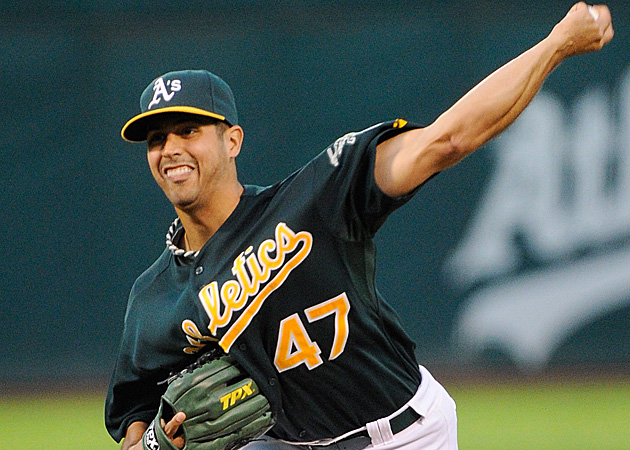
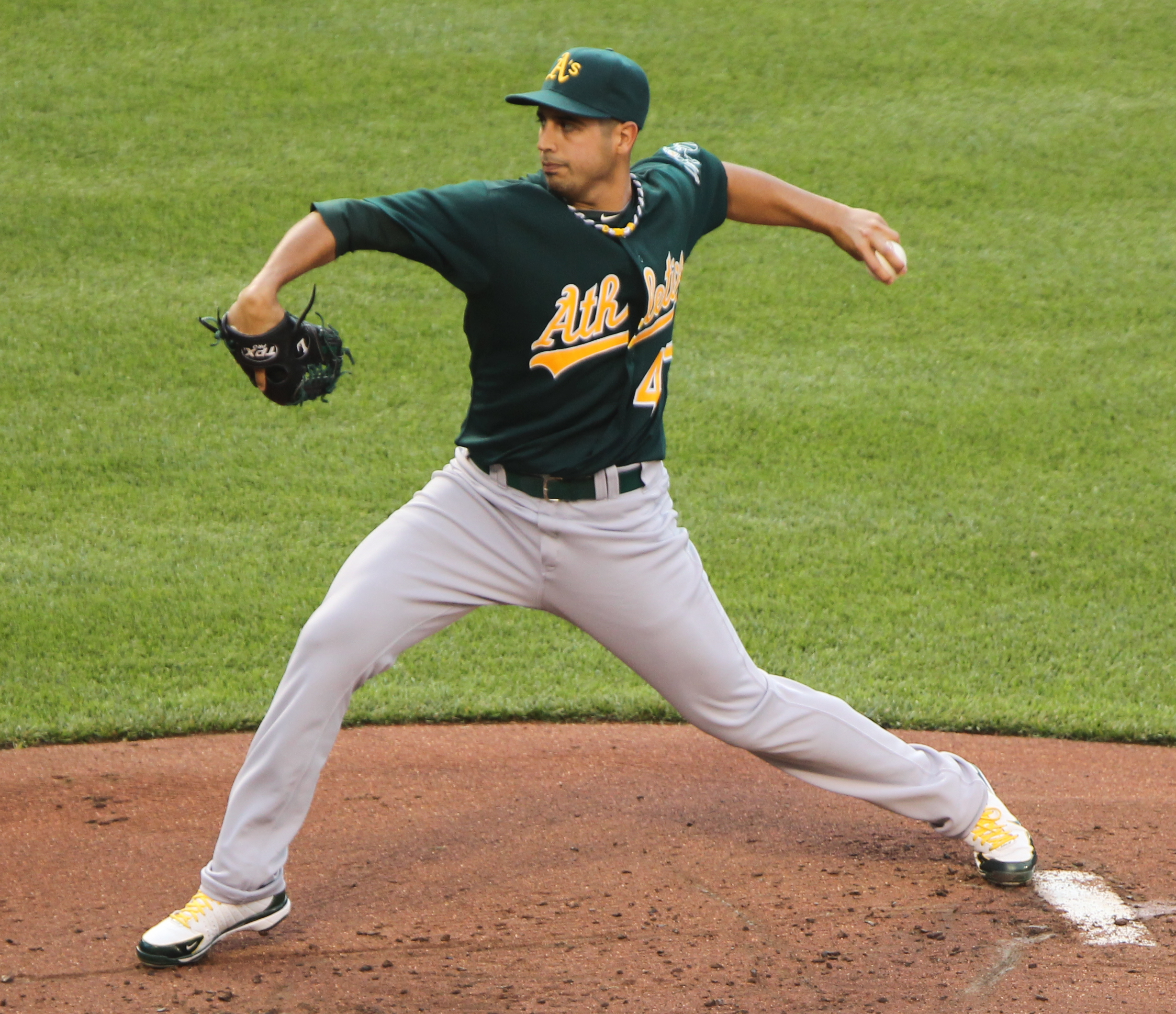
Newest National Gio Gonzalez
Gio Gonzalez is now a National and the Washington Nationals are now contenders. 

Just like that.

The American League all-star cost the Nationals Brian Peacock, Tommy Milone, Derek Norris and A.J. Cole, a rich haul to be sure. But none of those players were in the team's plans for 2012 and now a good rotation is close enough to great that it's no longer a long-distance call. 

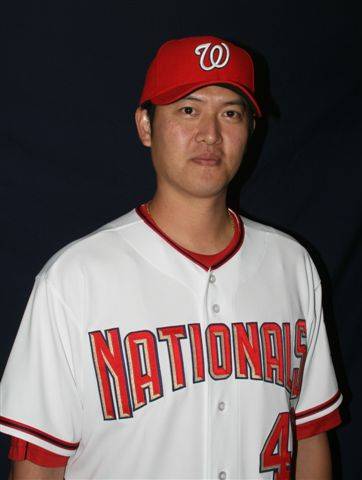
Gonzalez joins Stephen Strasburg and Jordan Zimmermann, giving the team as good a top-of-the-rotation as you'll find in the league. Add John Lannan and Chien-Ming Wang and there isn't a breather for the opposing team.

Take a look at these stats. Strasburg, Zimmermann and Wang's numbers are based on last year's numbers based on 30 starts. Lannan's and Gio's are their actual stats:

1--Strasburg: 12-8, 2.54 (6.9/1.9/11.3)
2--Zimmermann: 10-11, 3.18 (8.6/1.7/6.9)
Ross Detwiler
3--Gio Gonzalez: 16-12, 3.12 (7.8/4.1/8.8)
4--John Lannan: 10-13, 3.70 (9.5/3.7/5.2)
5--Chien-Ming Wang: 12-9, 4.04 (9.7/1.9/3.6)

And if one of them gets hurt, here are Ross Detwiler's numbers from last year, based on 30 starts:

6--Ross Detwiler: 12-15, 3.00 (8.6/2.7/5.6)

The four National League playoff teams from last season averaged 65 wins from their top five starters. The Nationals' top five listed above would have won 60 games. 

They are close, really really close. 


Wednesday, December 21, 2011

Mark DeRosa Ready To Join Nationals

It looks like Mark DeRosa is going to be joining the Nationals in 2012.

The 36-year-old will be the team's super-utility player. In 2009, his last full year in the majors, he played significant time at first base, third, as well as both left and right field.

From 1998 through 2005, DeRosa was mostly a part-time player, averaging .263/.320/.380 with 3 home runs and 13 RBI. But over the next four seasons, he was an every-day player, hitting .281/.356/.448 with 17 homers and 80 RBI. 

Injuries, though, have kept him either on the disabled list or the bench the past two seasons. He hit just .194/.279/.258 in 2010 with the Giants in just 93 at-bats. He rebounded somewhat last year, hitting .279/.351/.302 in 86 at-bats with San Francisco.

He has played for Atlanta, Texas, Chicago and San Francisco over his 14-year career.

Dear Mike Rizzo: Forget Fielder, Keep Adam LaRoche

In most every story written about premier free agent first baseman Prince Fielder, the Washington Nationals are listed as one of the teams pursuing him. 

Some suggest the team is making the 27-year-old a signing priority while others say they are at least in the mix.

If the Nationals were to somehow sign Fielder, he will end up costing them more than $20 million a year. Does that make sense for Washington, who still controls Adam LaRoche for another year?

Here are the two player's stats based on their last five years and based on a playing 162 games (LaRoche's numbers are based on 2006-2010 because of his injury-shortened 2011 campaign):

Fielder: .284/.400/.537, 38 home runs, 112 RBI

LaRoche: .273/.343/.493, 29 home runs, 99 RBI

Over the course of a full season, Fielder will reach base 39 more times than LaRoche, will hit 9 more home runs and drive in 13 more runs.

Defensively, Fielder is adequate and LaRoche, while not a Gold Glover, is close to it. 
Adam LaRoche will earn $8 million in 2012 while Fielder will probably sign a contract worth $23 million or so over seven or eight years.

Is that additional offensive production (roughly one run every 12 games) worth the extra $15 million, especially when those extra 13 runs will probably be offset by Fielder's so-so glove?

Absolutely not. 

LaRoche--assuming he is healthy this season--will hit 25 or so home runs and drive in close to 100 runs. Next season, Michael Morse will return to first base and the top-rated prospect in all of baseball--Bryce Harper--will take over in left. 

And with the $15 million that the Nationals would save by not signing Prince Fielder, the Nationals could acquire a top-of-the-line center fielder.

Sometimes, the best thing to do is to do nothing. The Nationals can contend in 2012 with Adam LaRoche at first. Prince Fielder would be little more than decoration for the Nationals. 

Very expensive decoration. 

Chatter About Gio To Nationals: I Say Go For It

Ken Rosenthal reported on Monday night that the Washington Nationals are trying very hard to get a deal done for the Oakland Athletics' Gio Gonzalez.

Reports suggest some type of a four-for-one trade would be needed to obtain the lefty 26-year-old from the Athletics. 

Because he plays in a division far far away and in a league we almost never see, Gonzalez isn't a well known commodity to most Nationals fans. 

But he is a really good pitcher. 

A lefty, the six-foot, 200 pounder has averaged 16-10, 3.17, 7.7/4.1/82 over the last two seasons.

He is controllable for the next four years and would provide the Nationals a fifth solid arm for next year's rotation. Stephen Strasburg, Jordan Zimmermann, Gonzalez, John Lannan and Chien-Ming Wang would in all likelihood comprise a playoff rotation. 

Who would the Nationals be willing to give up for Gio Ganzalez? Certainly the Athletics would want to replace Gonzalez in the rotation, and Ross Detwiler would fit the bill. They'd need to throw in another starter, someone like Tommy Milone, Daniel Rosenbaum or Brian Peacock (probably Peacock). Catcher Derek Norris would certainly make sense, and adding Roger Bernadina as one of those change-of-scenery-might-help players might sweeten the deal.

This time last year, the Nationals had completed a 4-for-1 trade for then Royals' starter Zack Greinke but it fell apart when Greinke invoked his no-trade clause and ended up in Milwaukee.

But the team wasn't close enough to contention at that time and adding Greinke at the cost of the team's future made no sense. But it does now. Stephen Strasburg is healthy. Danny Espinosa is a Gold Glove second baseman with power. Micahel Morse is a 30-home run power hitter.

And Wilson Ramos is a superb catcher.

Now is the time to give up prospects--especially blocked ones like Norris--and turn a good starting rotation into a great one.

Hey Mike, the time has come. Make the deal.

Monday, December 12, 2011

For the Nationals, There Are A Lot of Good "Plan B's" Out There

Just because the Washington Nationals struck out at the just completed Baseball Winter Meetings, there is no reason for the team to throw up their hands and say, "Well, at least we tried." Team General Manager Mike Rizzo went for the creme of the free agency crop, and creme is always more expensive than the milk that is left behind.

Maybe for the Nationals, milk is just fine.

This Nationals team has the capability to contend in 2012, even without that much needed middle-of-the-rotation starter and a top center fielder. So why not split the difference and get a couple of good-but-not-great players through a trade, from perhaps a team that is going to continue the fire sale that began last season.

There wasn't much left in the Houston Astros outfield after Michael Bourn and Hunter Pence was traded away. But one player remaining could certainly help Washington.

Jason Bourgeois is a 29-year-old outfielder who played for three teams in three years before returning to Houston last season. Playing half the season, Bourgeois hit .294/.323/.357 and if you base his stats on a 500 at-bat season, would have collected 140 hits, 16 doubles, 4 triples, 2 home runs, 32 RBI and 64 stolen bases. He doesn't hit righties as well as I'd like, but he does play a solid center field. 

You would think that a 29-year-old player with just 401 career at-bats wouldn't cost much in a trade, and Bourgeois could be a quality stop-gap until such time when whatever happens in the Nationals outfield (say: Bryce Harper) happens. 

I think Bourgeois would provide she short-term relief the Nationals are seeking, both in center at as a leadoff batter.

And if the Nationals are still seeking that veteran starter capable of throwing 200 innings, the team would need look no farther than a few spots up the Astros roster until they find the name Wandy Rodriguez.

At 32, Rodriguez is John Lannan with a higher strikeout rate. Over his last four seasons, Rodriguez has averaged 13-12, 3.40, 8.6/3.0/8.2. He's old enough now that he'll never be around when the Astros begin to win with the talent they have been acquiring the last couple of seasons. 

Both players will cost the Nationals minimal salary increases. Wandy Rodriguez will make $11 million over the next two seasons before he gains his free agency while Bourgeois will make $500,000 dollars in 2012. 

To get the two players, the Nationals will likely offer one or two of their young pitchers, perhaps Tommy Milone and A.J. Cole. Thrown in as well to cover Bourgeois would be someone like Roger Bernadina, someone who has the ability to be an everyday player but has yet to do it.

That's a win-win for both sides and gives the Nationals a serviceable outfielder and a solid pitcher. 

Here's hoping that the Nationals don't stop looking because they didn't get their first choice to take to the dance.

Friday, December 9, 2011

Nationals Should Have A "Plan B" And His Name Should Be Edwin Jackson

Now that the Washington Nationals have missed out on both Mark Buehrle and C.J. Wilson, they claim that the team really never had a "Plan B," and that they are content heading into the 2012 season with a rotation made of players they now control.

I have no problem filling the back of the rotation with John Lannan, Chien-Ming Wang and Ross Detwiler or Brad Peacock, but if the team really wants to contend next year--or at least try to--they need to add one more top-of-the-rotation starter to  join Stephen Strasburg and Jordan Zimmermann.

My guess is general manager Mike Rizzo is still looking for another starter, and Roy Oswalt certainly remains a potential target.

But there are several quality starters still available, some with the same talents and statistics that made Mark Buehrle and C.J. Wilson so intriguing. 

What about them? 

What about, say, Edwin Jackson?

Jackson is an aggressive pitcher with a good fastball. He pounds the strike zone and breaks bats. His problem, though, is with his control. When he can't find the strike zone, he forces his team to endure long at-bats and even longer innings.

That said, he would be an ideal number-three starter. Over the past four seasons, Jackson has averaged 12-10 with a 3.99 ERA, allowing 9.4 hits and 3.2 walks while striking out 6.7 batters per nine-innings.

No, that's not great, but it's pretty good. And Buerle would have cost the Nationals more than $15 million, about twice what Jackson would cost. 

Picture what Jason Marquis did for the Nationals last season before his trade to Arizona and that's what the Nationals would likely get out of Jackson. In 20 starts last year, Marquis went 8-5, 3.95, 9.8/3.0/5.3. During his time in Washington, he was the team's second-best pitcher behind Jordan Zimmermann.

Marquis cost the team $8 million per season and would have won 10-12 games had he remained all year. Jackson will cost the team about $8 million and would win 10-12 games for the Nationals. 

Jackson, however, is just 27, five years younger than Marquis, and has the talent to improve as his career progresses.

Sign Jackson to a three year contract (or a two year deal with a club option) and then trade Ross Detwiler, Tommy Milone or Brad Peacock as part of a package for that coveted center fielder.

Someone like Adam Jones of the Orioles.

Just because the Nationals didn't get the pitcher they wanted doesn't mean they still can't the pitcher they need.

Wednesday, December 7, 2011

With Whispers of Adam Jones Availability, What Would The Baltimore CF Cost The Nationals?

The Washington Nationals came to Dallas intent on signing a veteran pitcher capable of both leading and teaching their youthful starting rotation.

Mark Buehrle was "Plan A" and team GM Mike Rizzo was so confident that a deal could be reached that he really didn't have a "Plan B."

In most years, Washington would have signed the 32-year-old with relative ease, but this isn't most years. With the Miami Marlins working feverishly to stock talent to play in their new stadium, they swooped in and offered more money--and more years--and now Mark Buehrle is a Marlin.

Both Rizzo and manager Davey Johnson have repeated this evening that the team is content to head into next season with the rotation they now have. Stephen Strasburg, Jordan Zimmermann, John Lannan, Chien-Ming Wang and probably Ross Detwiler, they believe, should be enough to help the Nationals contend in 2012.

And they are probably right.

But for that to happen--for the Nationals to be able to rely on that rotation--they must come up with a proven center fielder. Names like Denard Span, B.J. Upton and Peter Bourjos are most often mentioned and any of them would fit the bill nicely.

But if the Nationals can't strengthen their rotation, their new center fielder needs to be really special, someone who can be a difference-maker every time he steps to the plate.

Someone like Adam Jones.

New Orioles' general manager Dan Duquette has been saying all week that he is not looking to trade the talented center fielder, that he would have to be "blown away" to make a deal.

General managers say that a lot, don't they?

Jones is the kind of guy a GM would be willing to trade multiple prospects for. He came to Baltimore from Seattle in a multi-player trade that sent Eric Bedard to the Mariners. 

Over the last three years, Jones has averaged .281/.326/.455 with 25 home runs and 86 RBI. He's been an All Star and has won a Gold Glove.  

And he is only 25.

Normally, this is the kind of player a team would want to build a team around. But the Orioles won just 69 games in 2011. A once promising young rotation has shown itself to be far more young than promising and their few decent everyday players have shown themselves to have gaping holes in their game.

Mark Reynolds, for example, hit 37 home runs last year but struck out 196 times and batted just .221.

They remind me a lot of the Washington Nationals of three or four years ago. 

Other than center, only shortstop (J. J. Hardy, .269-30-80), right field (Nick Markakis, .284-15-73) and catcher (Matt Weiters, .269-22-68) seem manned by players that are part of the Orioles' long-term plan.

Adam Jones is a tremendous player. If the Orioles are willing to trade him, it is going to take some real prospects to land him.

What would it take?

1--Stephen Lombardozzi, who has a career minor league slash line of .298/.369/.411 and won a minor league Gold Glove last year.
2--Brad Peacock, who was named Double-A Pitcher of the Year in 2011 after going 15-3, 2.39 for Double-A Harrisburg and Triple-A Syracuse
3--Roger Bernadina, who though he averaged .245-9-37 the past two seasons still has the talent to be an everyday player
4--A medium level prospect, someone like Tyler Moore who has averaged 30 homers over the past two seasons, or a better prospect who is younger and still in the low minor leagues.

The Nationals are ready to contend beginning in 2012, and the addition of Jones will give the team a formidable outfield with Michael Morse in left and Jayson Werth in right. Morse will likely move back to first in 2013 with Bryce Harper replacing him in left.
Obviously, there is much to look forward to for Nationals fans.

Tuesday, December 6, 2011

Ross Detwiler The Answer For Washington Nationals If Team Can't Find Another Starter

Last night, the rumor mill had it just a matter of time before C.J. Wilson signed a six-year contract with the Washington Nationals. Then--just like that--came a flood of denials from team sources saying they made no such offer.

Now the word is the Nationals aren't terribly sure they will be able create enough distance between themselves and the other suitors for Mark Buehrle, the pitcher they have always wanted. Suddenly, manager Davey Johnson is making himself available to the media. telling anyone who will listen that all is well with the team's rotation.

In one of the first scrums of the morning, Johnson said, "You know, I really like my staff. I like it as it is right now. Any time you can improve, go for it, [but] I haven't been pushing in that direction."

So what does that mean? If the Nationals return home with no additional starters to shore up the rotation, can the Nationals really, truly contend in 2012?

Yes, I think so.

Let's take a look at how the existing rotation members might do in 2012. The wins and losses are based on them pitching for a team with a good but not great offense and an outstanding bullpen. All the other stats are based on their career averages (or last season's numbers if necessary)

Stephen Strasburg (22): 12-6, 2.54 (6.9/1.9/11.3)

Strasburg, if he's not the best pitcher in the National League on opening day, will be by season's end. Though his season will end early as he continues to rehab from Tommy John Surgery, his 160 innings will be enough to at least place the Nationals in a position to contend for a Wild Card berth.

Jordan Zimmermann (25): 12-8, 3.18 (8.9/.2.2/7.7)
Strasburg

Zimmermann blossomed into the pitcher the Nationals thought he would be in 2011. Over his first 18 games, he went 6-7, 2.66 with 82 strikeouts and just 21 walks in 115 innings. His opponents offensive slash line was just .237/.275/.328.

Over his last 10 starts, he tired and his numbers suffered, though not that badly. Zimmermann went 3-4 with a 4.14 ERA and a .278/.325/.457 slash line.

I wouldn't be surprised if Zimmermann out pitches Strasburg in 2012.

John Lannan (26): 11-9, 3.75 (9.4/3.7/4.7)

John Lannan is the reason I don't think the Nationals really need Mark Buehrle. Though the former White Sox southpaw has been doing it longer, their internal numbers are quite similar. The biggest difference is that Lannan has played his entire career for a loser, Buehrle for a winner. 

Other than that, they are similar enough that the Nationals would only be a little better with Mark Buehrle in the rotation because, obviously, if Mark Buehrle comes, John Lannan goes, probably packaged in a deal designed to bring the team that center fielder they so badly want.

Chien-Ming Wang (31): 9-9, 3.86 (9.6/2.7/5.5)

Wang
After getting the rust out of his system--his first two starts were pretty bad--Wang reverted to pre-injury form last summer. In nine starts, he went 4-1, 3.71 (.251/.292/.391 opponent slash line). Those numbers are pretty much identical to his two All-Star seasons with the Yankees in 2006-2007 when he averaged 19-7, 3.68. 

Wang is 100-percent healthy and could provide top-of-the-rotation quality from the back of the Nationals' rotation.

If the Nationals don't come up with that fifth starter, the team does have several youngsters to choose from, any of which could provide starts almost as good as Mark Buehrle or Roy Oswalt or C.J. Wilson:

25-year-old Ross Detwiler first pitched in the major leagues in 2007 and over the past two seasons has started 23 games, roughly what a number-five starter might over the course of a full season. Over that period, Detwiler has gone 5-8 with fine ERA of just 3.39, giving up 9.1 hits and 3.2 walks while striking out 5.5 per nine-innings.

He's ready. He has thrown 172 major league innings and has enough experience to grab the number-four spot in the rotation. If given the chance, a 10-10, 3.75 type of record would be very realistic.

24-year-old Tommy Milone has had an amazing minor league career since joining the Nationals' organization back in 2008. Over four seasons, the southpaw has a career record of 37-22 with an ERA of 3.05, walking just one batter per nine-innings while striking out 8.1. 

In five starts with the Nationals last fall, Milone went 1-0 with a 3.81 ERA, walking just 1.4 batters per nine-innings and striking out 5.2. 

Milone is very similar to Lannan but his deceptive follow through garners far more strikeouts while at the same time walking just a third of the batters than Lannan does. 

Milone is ready and could take over a spot in the rotation if needed. 

Brad Peacock came out of nowhere in 2012 and was named baseball's Double-A pitcher of the year after going 10-2, 2.01 with the Harrisburg Senators. He was promoted to Triple-A Syracuse and did almost as well, going 5-1 with a 3.19 ERA.

In 12 September innings, Peacock went 2-0 with a 0.75 ERA. He only allowed 5.3 hits per nine-innings but walked 4.5, much higher than his minor league career average. His strikeouts were down too, fanning just three per nine-innings. 

Though Peacock without question has the best stuff of the three, he may need a little more time refining his skills in the minor leagues. And while Milone gets by on guile and grit (and an 88mph fastball), another few months of minor league experience will only help him.

Ross Detwiler
That means that Ross Detwiler is the guy most likely to fill the hole in the rotation if the Nationals can't find that starter they are looking for. That said, a full season of Detwiler will likely bring two or three fewer wins than a full season of Mark Buehrle, which isn't enough to keep them out of a Wild Card hunt but could be enough to allow a team to sneak past them in the standings. 

I still believe that the best bet for the 2012 Nationals would be to sign Roy Oswalt to a two-year deal, move John Lannan down to the number-four starter, and give the kids one more year to polish their game before joining Washington for good in 2013.

Monday, December 5, 2011

Nationals Already Have Answer To Outfield Problem: His Name Is Bryce Harper

Bryce Harper & Jayson Werth: The Future Is Now
After months of repeatedly telling us that priorities at the Winter Meetings would be a starting pitcher and a center fielder, we are now hearing that the Washington Nationals just might start Jayson Werth in center next season and insert Bryce Harper in right.

This whole process is a lot like buying a car at a dealership. No one tells the truth and no one expects you to. That said, what are the Nationals really up to? Are they really content moving Werth to center or was that statement for agents and players as part of the bargaining process?

Personally, I would much rather let Bryce Harper start in right on opening day and give him the opportunity to learn how to hit major league pitching sooner rather than later.

The last thing the team needs is to insert some stop-gap, good-enough-but-not-great center fielder into the lineup until Harper is ready.

Harper is a good enough hitter that he could overcome a potential slow start as he learns how to hit major league pitching and end the season with acceptable-to-good numbers. Unlike Danny Espinosa, who was unable to make corrections last year when major league pitchers figured him out, Harper is a student of the game and more than capable to make corrections as the season progresses.

Coco Crisp: No Way He's Better in 2012 Than Teen Harper
Given a full season, Harper should be able to hit .270/.340/.475 with 20 home runs and 70 RBI, give or take. And by 2013--when the Nationals should really be able to contend--he would have had enough time at the major league level to hopefully blossom into the star we all think he'll become.

Hopefully, team general manager Mike Rizzo comes away from Dallas with that starting pitcher he wants, but really, the outfield should be just fine.

All Bryce Harper needs is a chance.

Saturday, December 3, 2011

Does A Potential Mark Buehrle Signing Make The Nationals That Much Better?

Mark Buehrle -- Next Nationals Starter
Washington Nationals' general manager Mike Rizzo has made it clear that by the time baseball's Winter Meetings conclude next week in Dallas, he wants to have come away with a veteran starting pitcher capable of not only being the rotation's leader but also its teacher.

C.J. Wilson, Mark Buehrle and Roy Oswalt are the three most likely candidates that Rizzo is pursuing. If the team signs either lefty--Wilson or Buehrle--the Nationals will probably package John Lannan with a couple of  prospects to get that last piece of the we-are-ready-to-contend puzzle, a center fielder able to lead off.

Reports indicate that Buehrle is the pitcher Rizzo wants the most and it looks like he may command a three-year, $45 million contract with an option year. Lannan will probably make an arbitration-enabled $3.5 to $4 million in 2012.

Is Buehrle worth that much more? Here are their 2011 statistics:

Mark Buehrle:  13-9, 3.59 (9.7/2.0/4.8)
John Lannan:   10-13, 3.70 (9.5/3.7/4.7)


Not too much of a difference, at least when you compare what their incomes will be in 2012.

The bottom line, then, based on their respective 2011 stats:
1--Over the course of a nine-inning game, Lannan will give up 1.5 more base runners than Buehrle
2--Over a 200 inning season, Lannan will give up 82 runs, Buehrle 79.

So over a full season (30 starts and 200 innings), John Lannan will allow 45 more base runners that will translate into three more earned runs.
John Lannan: Mr. Consistency
How much better would essentially trading Lannan for Buehrle make the Nationals? Not much, really. But if Buehrle signs as the number-three starter and Lannan moves down to number-four, that fill out a  very nice rotation.

Here would be the starters and their probable (but it's a guess) ERA's:

1--Stephen Strasburg (3.00)
2--Jordan Zimmermann (3.20)
3--Mark Buehrle (3.50)
4--John Lannan (3.75)
5--Chien-Ming Wang (3.60)


That is a rotation capable of winning one of the two National League Wild Card spots.

And of course the team will need one or two more starters to cover for injuries and poor performance. It's that way every season.

Brad Peacock: Needs His Own Rotation Spot
How about one of these three (2011 stats shown):

1--Ross Detwiler: 4-5, 3.00 (8.6/2.7/.5.6)
2--Tommy Milone: 1-0, 3.81 (9.7/1.4/5.6)
3--Brad Peacock: 2-0, 0.75 (5.3/4.5/3.0)


I'm not sure I see a kink in the Nationals' pitching armor as long as Lannan remains in the rotation and it wouldn't surprise me--especially if they find that coveted center fielder--for the team to head into the last weekend of play with a playoff spot already secured.

Wednesday, November 23, 2011

With New CBA In Place, Nationals May Kick-Start Last Phase Of "The Plan"

Jim Bowden At His First Press Conference In D.C.
"The Plan" is not something we've heard much about recently.

It wasn't too long ago that the Washington Nationals divested itself of any meaningful talent, trading the few quality players they had away for prospects while hoarding their draft picks in the yearly amateur draft.

In some point in the future, we were assured, the team's young talent would rise like cream to the top, filling all of the gaping holes on the major league roster.

And it seemed to work.

Last season, five of the team's eight starting position players were either cultivated through the team's minor league system or received as minor league prospects through trades. The same goes for three of their starting pitchers and their top two relievers.

In another two or three years, another crop of young pitchers will be ready to make the jump to the major leagues, giving the team one of the most formidable young rotations in the game.

Oh, and that kid, you know, the one who is supposed to be maybe the best hitting prospect since Ken Griffey Jr, he'll certainly be in the starting lineup by 2012.

I think his name is Bryce Harper.

Ken Griffey Jr.
But the way baseball operates has undergone a major change in the last few weeks, enough so that the Nationals might not want to wait for the next wave of rookies to mature.

With the handshake that accompanied the new Collective Bargaining Agreement, new rules have been placed in effect that may force the Nationals to look for those final pieces for a pennant run earlier than expected.

First, the addition of a second wild card entrant--possibly next year but no later than 2013--makes it much easier for a good-but-not-great team to get into the playoffs. As Thomas Boswell of the Washington Post pointed out in yesterday's column, all but one 90-win team over the past 15 years would have gotten into the playoffs under the new system.

Secondly, the cost for signing premium free agents has been reduced. Though the formula has become more complicated--no more "Type A" and "Type B" free agents, a team can still lose its top draft pick if the player was offered arbitration, but the guaranteed salary they would be forced to pay is so high that its likely that fewer players will be offered arbitration. My guess is this will allow the Nationals to be more aggressive with their free agent offers this winter.

And lastly, Washington will never again be able to do what they did last summer. The Nationals were able to draft four players with first round talent and then went way over-slot to sign them. New rules will make this a near impossibility in the future.

The Nationals, then, have three good reasons to make a splash this off season. Baseball Karma has given them a golden opportunity, if, that is, they can get to 90 wins. That means they will have to find a way to win 10 more games than last season.

How do they do it?

Having Stephen Strasburg (1-1, 1.50) back  will certainly help. He'll be worth at least a couple of more wins in his first season back from Tommy John surgery. Jordan Zimmermann (8-11, 3.18) will be available for the entire year and should give the Nationals another win. And Chien-Ming Wang (4-3, 4.04), who pitched in the majors for the first time in almost three seasons, will be far better as the team's number-five starter than was Tom Gorzelanny last year. Count on an extra win from him.

That's four wins down and six to go.

First baseman Adam LaRoche has a career 162-game average of .267-26-92 to go along with his stellar defense. Last year, arm and shoulder problems limited him to .172-3-15 in just 43 games. He is working out now in Phoenix is should be 100% ready by the beginning of spring training. A healthy LaRoche has to be good for another two wins.

All Star third baseman Ryan Zimmerman is also coming off an injury-plagued season.  The 26-year-old played in just 101 games and his power was sapped due to an abdominal injury. A healthy Zimmerman will add another win, easily.

That gets the Nationals up to 87 wins, give or take.

The team can likely find two or more wins if they are able to sign or trade for a quality, veteran pitcher, someone along the lines of Roy Oswalt, Mark Buehrle, C.J. Wilson (as free agents) and Wandy Rodriguez or Gio Gonzalez as potential trade targets.

That puts the team at roughly 89-73.

If the Nationals stay with an in-house solution in center, someone like Rick Ankiel or Roger Bernadina, they are not going to find the extra win or two among that group.

But you would think that the maturation of the team's younger players should be worth a couple of wins. Take a look at what those players did in 2011 and what they should be able to do this year:

Wilson Ramos: (2011) .267-16-52      (2012) .265-20-65
Danny Espinosa: (2011) .236-21-66     (2012) .260-25-75
Ian Desmond: (2011) .253-8-49          (2012) .270-10-50

If all goes well, if there are no heartbreaking injuries to deal with, or Werth-like slumps to live through or jaw-dropping regression by the kids to watch in stunned silence, the Nationals should finish the year with 85-90 wins in 2012, perhaps 92-93 if they find both that veteran pitcher and quality center fielder they are after.

Based on history, 89 wins could get them in the playoffs if the second wild card spot is available in 2012, and 90 wins will.

Can they make it? Here's hoping.

Tuesday, November 22, 2011

OSWALT OR BUEHRLE OR WILSON, OH MY!


With baseball’s annual Winter Meeting now three weeks away, Nationals’ general manager Mike Rizzo continues to focus on adding an experienced center fielder and a veteran starting pitcher.

Roy Oswalt -- The Best Fit In Washington?
My guess is that if Rizzo is going to make a splash at the meetings, it’s going to be with a pitcher. If they have to, the Nationals can probably get by with a holdover from last season (Rick Ankiel or Roger Bernadina) or a platoon of veterans capable of giving the team some steady-if-unspectacular offense while providing steady defense.

But adding another veteran starter is imperative if the team is going to make a true pennant run. Sure, Brad Peacock or Ross Detwiler or Tommy Milone might come out of nowhere and give the team 12-14 wins, but they probably won’t.

One more quality starter to go along with Stephen Strasburg, Jordan Zimmermann, John Lannan and Chien-Ming Wang could actually make the Nationals—gulp, dare I say it?—an early favorite in the hunt for one of now two Wild Card berths.

There are several pitchers that meet Rizzo’s requirements, namely a veteran, “innings eater” type who doesn’t have a history of injury problems.

Right now, Mark Buehrle, Roy Oswalt and C.J. Wilson are the most coveted of the available free agents.

Who should be the Nationals’ top choice among the three? Let’s take a look at their comparative statistics:

Roy Oswalt (Age: 33)
Career Average: 16-10, 3.29, 8.7/2.1/7.9
2011: 9-10, 3.69, 9.9/2.1/6.0

TSN Scouting Report:

Assets:  Has pinpoint control and an ability to throw plenty of first-pitch strikes. He's also an innings-eater with a winning attitude and leadership qualities.

Flaws:  His diminutive stature has started to take its toll, as he's not as dominant as he used to be. Also gives up a few too many hits.
Mark Buehrle Seems GM Mike Rizzo's Favorite

Mark Buehrle (Age: 32)
Career Average: 15-11, 3.83, 9.5/2.0/5.1
2011: 13-9, 3.59, 9.7/2.0/4.8

TSN Scouting Report:

Assets:  One of the game's great work horses, he doesn't fatigue much late in the game. Logs a lot of innings, pitches to contact and can lead a staff. Is successful throwing an array of off-speed pitches.

Flaws:  When he loses focus, he gets knocked around for big innings. That's due to less-than-stellar velocity and average stuff. At times, he can take a while to regain his focus when on the mound.

C.J. Wilson Has Just 2 Years of Starting Experience
C.J. Wilson (Age: 30)
Career Average (as starter): 16-8, 3.14, 7.4/3.5/7.9
2011: 16-7, 2.94, 7.9/3.8/8.1

TSN Scouting Report:

Assets: Pitches aggressively with a low-90s fastball that has great movement. Also boasts a good curve and solid change-up. Constantly challenges hitters. Is capable of dominating left-handed batters. Can close, set up or start.

Flaws: Right-handed hitters have a little more success than lefty bats, so greater refinement in his pitches could help. Must improve his durability and stamina to thrive in the starting rotation.

There is no question that all three pitchers have the potential to help the Nationals become contenders, but that doesn’t mean they all bring the same abilities.

Of the three, Wilson will likely cost the most and require the longest contract. Reports from multiple sources indicate that he has set his sights on a six-year, $120 million deal. And while there is no way he’s going to get that much, he’s going to come close as the top free-agent pitcher of the litter.

I think a more likely scenario is $80 million over five years with an easy-to-reach sixth year option.

That is way too much money for any free agent pitcher not named Sabathia, but it is especially too much considering that Wilson has only been a starter for two years and has only 73 starts under his belt.

I mean, who’s to say that he won’t revert back to his days before becoming a starter when he averaged 4.1 walks per nine-innings and had a bloated 4.30 ERA?

With the kind of money Wilson is going to get, the Nationals can buy a quality starter and a decent center fielder.

Signing Wilson makes no sense, not from a talent perspective and not from a financial perspective. Let the Yankees overpay for him.

And though Mark Buehrle has been a model of consistency for the Chicago White Sox, his stats don’t suggest that he is anything more than a good, consistent pitcher.

Mark Buehrle Seems Too Much Like This Guy
 And those stats look close enough to current Nationals’ lefty John Lannan that I’m not sure it makes sense to give the 32-year-old what he’s asking for, and no, I’m not suggesting John Lannan is the same pitcher as Mark Buehrle.

But take a look at their career averages based on a 162-game season:

Mark Buehrle:
15-11, 3.83 ERA, 223 Innings Pitched, 9.5 hits per 9 innings / 2.0 walks per 9 innings /5.1 strikeouts per 9 innings.

John Lannan:
10-14, 4.00, 200 Innings Pitched, 9.4 hits per 9 innings / 3.4 walks per 9 innings / 4.7 strikeouts per 9 innings.

Their lines just aren’t as different as you would expect. Lannan’s ERA is a bit higher, and he gives up one more walk per game, but his hits allowed and strikeouts allowed are about the same.

But look at this: In 33 starts, Lannan gave up 90 runs. Buehrle allowed 93 runs in one less start. That’s as close to identical two pitchers can be without being exactly identical.

And Lannan averaged 5.6 innings per start while Buehrle went 6.5 innings per start.

Man, that’s just too similar.

I doubt that John Lannan is going to be as successful as Buehrle over his career—in fact, I think we can count on that—but that doesn’t mean they aren’t similar pitchers. True, Buehrle has averaged 15 wins per major league season and Lannan only 10, but Lannan has spent his career on a truly terrible team.

Over Buehrle’s career, the White Sox have averaged 87 wins per season, and in the three seasons where they finished below .500, Buehrle had three of his worst seasons, winning 10 games in 2007 and 13 in both 2009 and 2011.

Lannan’s Nationals, on the other hand, have averaged just 66 wins during his time in Washington, 21 games fewer than the White Sox. Had he played with the White Sox during that same period, he would have likely averaged 12-13 wins per season.

So really, Mark Buehrle is a 2-3 win improvement over John Lannan, and that just doesn’t warrant the millions it will cost the team to get him.

In the end, I think that the least attractive of the three free agents could be the best fit in Washington.

Of the three, Roy Oswalt will require the least amount of guaranteed money and the fewest number of guaranteed contract years, due in part to injuries that have slowed him over the last couple of seasons.

From 2001 through 2010, Oswalt averaged 30 starts per season, going 15-8 with a fine 3.18 ERA. But he was limited to just 23 starts in 2011 and injuries robbed him of some of his efficiency. He went 9-10, 3.69 last season, giving up two more hits per nine-innings and striking out two less batters per nine.

Zimmermann & The Other Kids Could Use A Teacher
But Oswalt would bring far more to the Nationals than wins. He is a leader in the clubhouse, just the kind of guy that Mike Rizzo likes. The top three Washington starters—Strasburg, Zimmermann and Lannan—are all 26 or younger and fourth starter Chien-Ming Wang, while 31, has just 115 career starts, a relatively small number for his age. John Lannan, four years younger, has 13 more starts than Wang.

Oswalt could bring a winner’s mentality to the starting rotation. He could be a teacher, a leader and darn fine starter. Because of his age, it is likely that Washington would not want to / have to commit to a long-term deal, making that rotational slot available to one the team’s young pitchers in a relatively short period of time.

To be able to contend, the Washington Nationals need a “rock” in the rotation to give the kids time to turn winning ability into games won. Once that happens—say in a couple of years—the team could then afford to bring in one of the bevy of young arms they have stockpiled and still contend.

The Nationals contention window will open with the beginning of spring training and looks like it could be a five-year window. For now, the team will need an influx of outside veteran talent to win before ultimately letting the maturing youngsters lead them through those outlying years.

No question, though: it’s going to be a fun ride over the next few years. And goodness knows, after the last seven seasons, we’ve earned it.